Low-cost stripboard weatherproofing
Trying to protect copper with whatever I had lying around the house.
After the failure of an electronics project in my garage due to corrosion, I conducted a small-scale personal experiment to evaluate possible materials for weather-proofing of stripboard using readily available materials. There are already several commercially-developed products for this purpose, but I have always supported a do-it-yourself approach and so evaluated three materials selected as potentially very-low-cost alternatives for hobby projects - and things I had lying around spare anyway. The experiment consists of a stripboard with four identical sample components, three protected and one control.
The test board
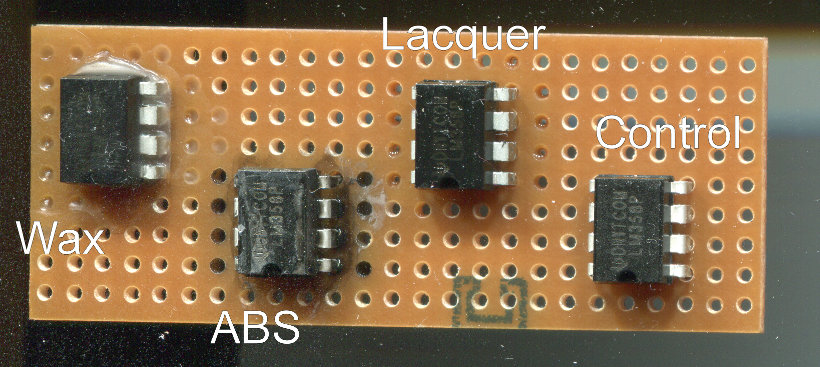
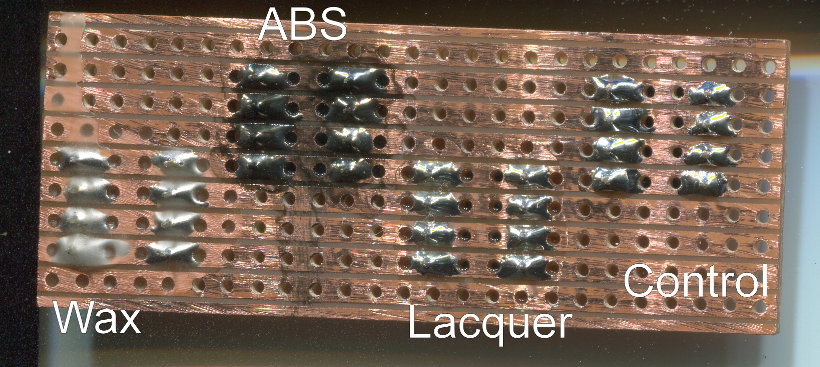
The control: An 8-DIP package IC with no protection at all. This incorporates the three materials of importance: Copper tracks, component legs and solder.
'Gaia color #008 flat coat' lacquer, intended for protecting model minatures.
'ABS juice': a saturated solution of ABS in acetone, a mixture usually used for improving adhesion in 3D printing. The acetone quickly evaporates, leaving a thin coat of ABS plastic behind. This coating is so thin, it will easily melt under the heat of a soldering iron and allow reworking. The solution itsself is an effective solvent though, and may damage some components.
Candle wax, half a teaspoon split between the two sides.
All coatings were given to both sides of the board.
Nineteen days of accelerated weathering
The test object was assembled and placed outside for weathering in the harsh conditions of a British winter: December, 2016. Set atop a table with a rim that collects snow and rail, the board endured nineteen days of intermittend immersion and temperature swings - at one point becoming embedded within ice as the puddle froze over. These conditions are far more severe than would be experienced by a board sealed in an enclosure.
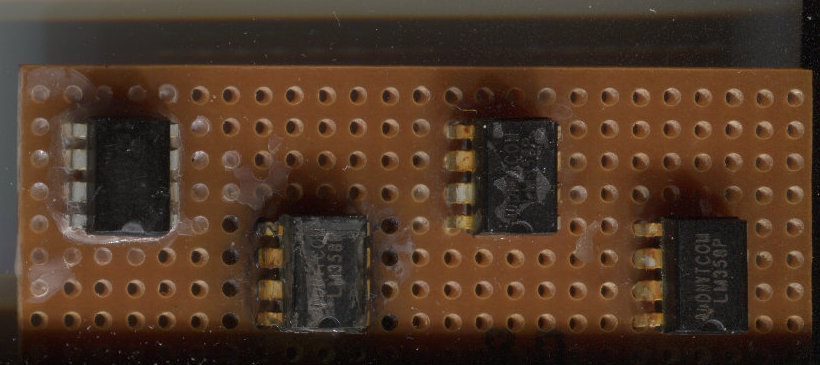
It is surprising just how poorly the weatherproofing performed. The control is already showing corrosion, and the ABS-coated sample is equally severe. This material has offered no protection at all. The laquer has offered some protection, but has not been entirely effective: It also shows corrosion, to a lesser extent. The wax, however, appears almost unchanged. Though cracks in the wax can be seen, there is no sign of corrosion at all. As wax though, it might fare worse under high temperatures.
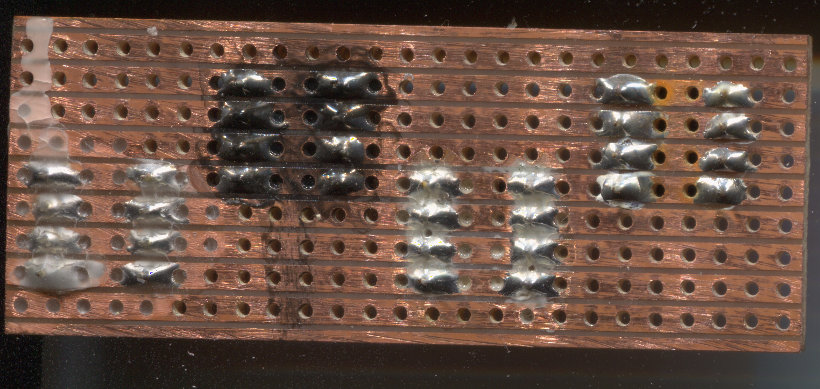
Corrosion of the lower side of the board shows much less damage: The control shows some slight discoloration from corrosion, while the three protected samples are not visibly corroded at all. It is evident that the component legs are far more susceptable to corrosion than either copper or solder.