Diode Function Generators, Revisited
published 2026-02-06
by Christopher Howard
I wrote about this a month ago:
I think my understanding of diode function generators was a bit fuzzy at the time I wrote that, as well as during my preliminary attempts to implement my own diode function generator, which didn't go well. Today I studied again the relevant pages in Hyndman's "Analog and Hybrid Computing" (1970), pages 28-35, and now I have a clearer understanding of how they work, and what is happening in the schematics. So I am hoping to take another stab at building one. Some obstacles at the moment are that I might not have enough three position switches and DPDT switches to implement a reasonable number of diode sections, as described in Figure 2.19 Variable function generator circuit. These switches allow you to do some important things for flexibility, specifically (1) ground out any diode section you aren't using and (2) configure a diode to work in any particular quadrant that you would like. Not that switches are ridiculously expensive, but the budget continues to be tight. And when I do get a few dollars to spare, it is a hard choice between spending it on yet another electronics parts order, vs. my long term savings goals. I am hoping to save up enough money for a new telescope mount, for my astronomical studies, which I'm thinking will likely cost around 200 to 300 USD.
It is possible to build functions directly on my THAT analog computer, which comes with four signal diodes, and of course some summer and inverter modules. Here are some output examples using two diodes:
output from THAT using two built-in diodes, function one

output from THAT using two built-in diodes, function two
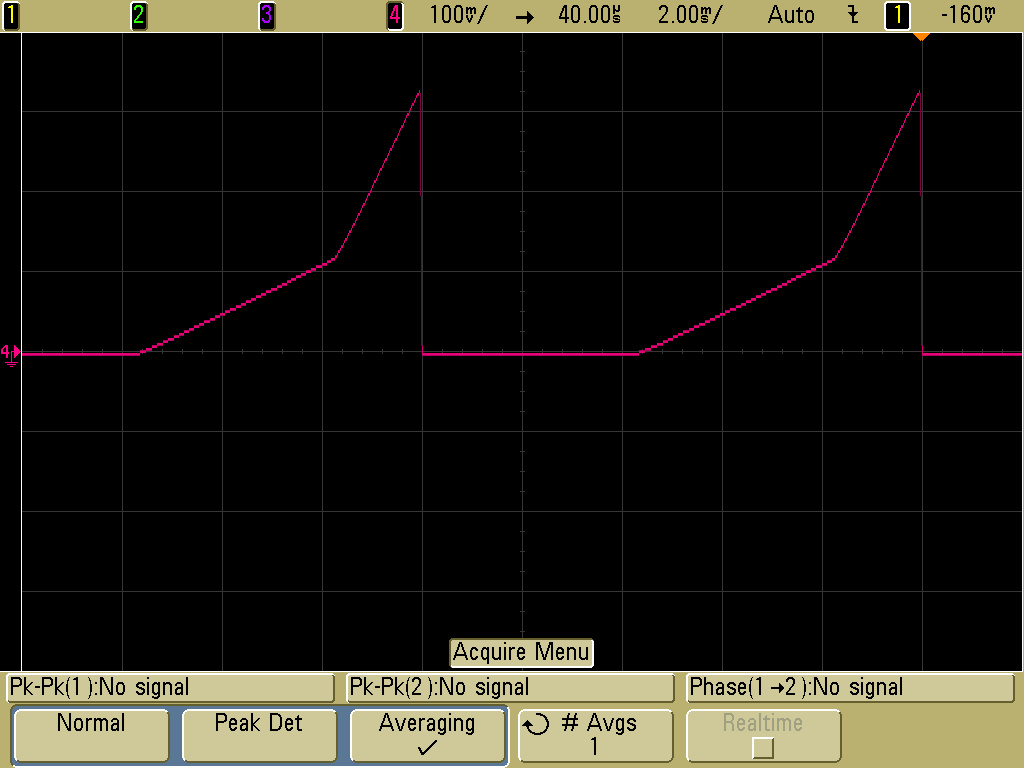
output from THAT using two built-in diodes, function three

Understand that, to generate these wave forms, I am feeding in a sawtooth wave that moves across from all the possible negative to positive voltages. So the middle of the waveform is zero volts input, five volts inputs is to the right of that, and so forth.
Using an entire THAT board to generate one function would not be ideal, as (1) there are a very limited number of spare diodes to work with; and (2) you want the THAT board to be handling the core parts of your simulation math, i.e., feedback loop or differential equation. The variable function generator module, on the other hand, is there basically to provide some data that can't be represented as a simple differential equation, usually some real world data gathered experimentally. A handy, though somewhat questionable example of such data would be the Coefficient of Lift and Coefficient of Drag curves for an aircraft wing, which vary somewhat depending on actual wing design, and are not linear everywhere. I say "questionable" because you can see how for most angle of attacks, linear and exponential approximations would fit well.
File:Coefficients of Drag and Lift vs AOA.jpg (Wikipedia)

Copyright
This work © 2026 by Christopher Howard is licensed under Attribution-ShareAlike 4.0 International.